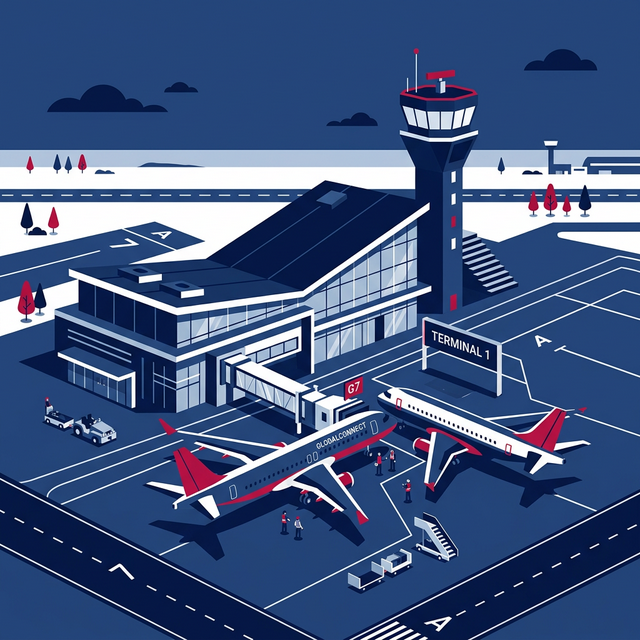
Flight Crew Duty Limits: It's Not Extraordinary
⚡ Key Takeaways for Flight Crew Duty Limits: It's Not Extraordinary
- Operational Failure: If a crew 'times out' (exceeds legal work hours), this is a 100% valid reason for compensation. It is an airline management issue.
- Poor Planning: The airline is responsible for having 'standby' crew. If they don't, and your flight is cancelled, you are owed up to €600.
- Fake Excuses: Airlines often call this 'Operational Reasons' or 'Staffing'; we verify the logs to prove it was a duty-limit failure.
Hearing a gate agent announce that your Turkish Airlines flight is cancelled because "the crew has timed out" is an intensely frustrating experience—made worse by the fact that the airline then tries to use this exact same announcement as legal cover to deny you the €600 cash compensation you are owed. Crew "timing out" refers to the moment when a pilot or flight attendant reaches the maximum number of consecutive working hours permitted by aviation safety regulators. While these hard limits absolutely exist for critical safety reasons, the responsibility for managing crew fatigue and ensuring reserve crew availability lies entirely with the airline's operations management team—not with passengers. Under EU261/2004 and Turkish SHY-PASS law, a crew duty limit timeout almost universally constitutes an operational failure, not an extraordinary circumstance.
1. What Are "Crew Duty Limits" and Why Do They Trigger Cancellations?
Aviation authorities—principally EASA in Europe and the DGCA in Turkey—enforce strict Flight Time Limitations (FTL) on cockpit and cabin crew. These rules exist explicitly to prevent pilot fatigue, which is a leading contributing factor in aviation accidents. Key limits include:
- Maximum Flight Duty Period: Typically 13 hours for a two-pilot crew on a single sector, less for shorter turnarounds.
- Maximum Block Hours: Pilots are capped at around 900 flying hours per year to prevent cumulative fatigue.
- Mandatory Rest: Crew must receive a minimum uninterrupted rest period (typically 10–12 hours) between consecutive duty periods.
These limits are non-negotiable. A captain who is at their legal maximum hours simply cannot fly the aircraft, even if a full planeload of passengers is waiting at the gate. The problem arises when Turkish Airlines' scheduling team fails to build adequate time buffers into crew rosters, or when minor earlier delays (which are entirely manageable) cascade into a situation where the assigned crew times out before the delayed rotation can depart.
The Key Legal Principle
Managing crew rosters, maintaining crew rest buffers, and having standby reserve crew available at major hubs like Istanbul Airport (IST) is a fundamental, foreseeable operational requirement of running an airline. The European Court of Justice has explicitly confirmed that a crew timeout resulting from an airline's own scheduling failures is not an extraordinary circumstance. It is an internal operational deficiency, making Turkish Airlines directly liable for your €600 statutory compensation.
2. The "Two-Step " Test: When Can TK Legitimately Blame Crew Limits?
Turkish Airlines' legal team is sophisticated. They understand that a pure "crew timed out due to our own scheduling failure" defense is indefensible in court. Instead, they will attempt to construct a narrative where an initial extraordinary event (a freak storm, an act of terrorism, a volcanic eruption) triggered a chain of delays that eventually caused the crew timeout.
To successfully counter your EU261 claim, the airline must prove both of these things under the so-called "two-step test":
Step 1: Genuine Extraordinary Origin
The airline must prove the root cause event was genuinely beyond their control—not a technical fault they blame on safety, but a true extraordinary event like a declared state of emergency, mass ATC strike, or severe weather event displacing the entire regional fleet.
Step 2: Reasonable Measures Taken
Even if Step 1 is met, the airline must prove they took ALL reasonable measures to minimize the delay. This specifically includes deploying standby reserve crew or releasing legally rested crew from another rotation to cover the delayed flight.
If the airline cannot produce evidence supporting both steps, their crew duty limit defense collapses and your claim succeeds. In the vast majority of Turkish Airlines crew timeout cases involving routine technical delays or operational cascade failures, the airline cannot satisfy Step 1 at all.
3. Decoding the Airline's Language
Turkish Airlines will never tell you, "We cancelled your flight because we did not have enough reserve crew available." Instead, they use deliberately vague, legally less exposing language designed to engineer a gray area.
- "Due to operational reasons" — This is an umbrella term covering crew shortages, slot restrictions, and fleet management failures. None of these are extraordinary circumstances.
- "Due to crew rest requirements" — This directly references the duty limit issue but frames it as an external safety mandate rather than the airline's own scheduling failure.
- "Due to technical issues affecting the inbound aircraft" — This classic deflection links a technical issue (which is also not extraordinary per EU case law) to the crew timing out, hoping passengers will not investigate the chain of causation.
- "Safety is our priority" — A moral shield designed to make passengers feel that questioning the cancellation is equivalent to demanding the airline ignore safety.
4. How to Build an Unanswerable Claim
When you are stranded at Istanbul Airport due to a crew timeout, follow these immediate steps to build the strongest possible compensation claim.
- Get Written Confirmation: Request a written statement from the gate agent or ground handling staff specifying the exact reason for cancellation or delay. "Crew rest requirements" in writing is gold-standard evidence.
- Track the Inbound Aircraft: Note your flight number. Use Flightradar24 to look up the tail number assigned to your flight. See how many sectors it flew that day and when delays began. A plane that accumulated 4+ hours of delays on earlier routine flights before your slot is almost certain proof of scheduling negligence.
- Request Care Provisions: Under Right to Care obligations, even for extraordinary circumstances, Turkish Airlines must provide meals, refreshments, and overnight hotel accommodation if required. If they refuse, pay out of pocket and save every receipt for reimbursement.
- File Your Formal Claim: Submit a formal compensation demand through the Turkish Airlines feedback system, the SHGM (Turkish civil aviation authority), or via AirAdvisor's legal team who can access primary source flight data to dismantle the airline's excuse professionally.
Was Your Flight Cancelled Due to Crew Timeout?
Crew duty limit timeouts are almost never extraordinary circumstances and you are very likely owed up to €600. Our aviation lawyers access professional flight data systems to prove scheduling negligence and force the airline to pay.
Written & Legally Reviewed by Anton Radchenko
Anton is the CEO and Lead Aviation Attorney at AirAdvisor. With over a decade of experience, he has successfully secured compensation for over 250,000 passengers against major airlines globally.