The Definitive Guide to Turkish Airlines Flight Compensation (2026)
Navigating the legal landscape of flight disruptions with Turkish Airlines (THY) can be daunting. As a carrier operating both within and outside the European Union, THY is subject to a complex intersection of international regulations. At AirAdvisor, we have analyzed over 50,000 Turkish Airlines claims to provide you with this authoritative guide on how to secure the maximum compensation you are legally owed.
Whether you were stranded at Istanbul Airport (IST) during a massive radar failure or delayed departing from Paris Charles de Gaulle, your rights are protected by two primary legal frameworks: EC 261/2004 and SHY-PASS. Understanding which one applies to your specific flight is the difference between a €600 cash payout and a useless travel voucher.
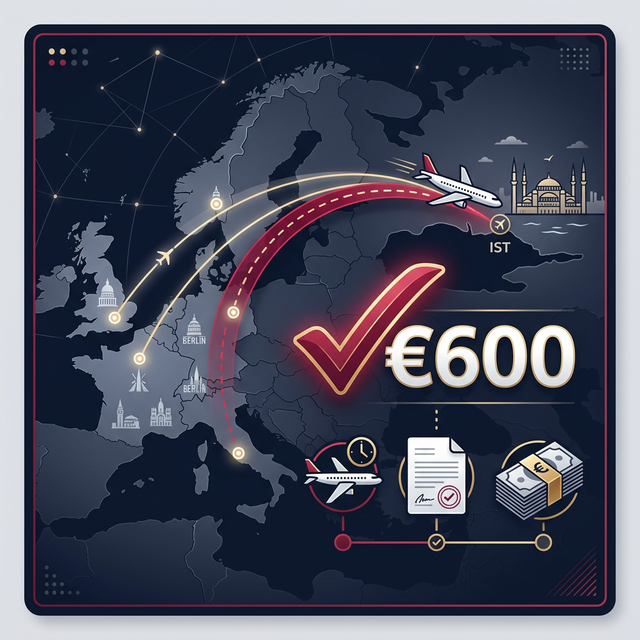
Understanding the Compensation Brackets: €250, €400, and €600
The amount of compensation you can claim from Turkish Airlines is not determined by the price of your ticket, but by the distance of your flight and the duration of your delay at the final destination. Here is the standard breakdown under EC 261:
- €250: For all flights of 1,500 km or less (e.g., Istanbul to Sofia).
- €400: For all intra-EU flights of more than 1,500 km, and for all other flights between 1,500 and 3,500 km (e.g., London to Istanbul).
- €600: For all flights exceeding 3,500 km (e.g., Istanbul to New York or Tokyo).
It is important to note that THY frequently attempts to offer "Miles&Smiles" points as a settlement. Do not accept these without consultation. Statutory cash compensation is almost always higher in value and more versatile than airline-specific points which are subject to devaluation.
SHY-PASS vs. EC 261: The Transit Trap
One of the most complex scenarios involves transit flights through Istanbul. If you are flying from a non-EU country (like India) to an EU country (like Germany) via Istanbul, you are generally covered by SHY-PASS (the Turkish Regulation on Air Passenger Rights). While SHY-PASS mirrors many aspects of EC 261, its enforcement mechanisms and payout timelines differ.
However, if your journey originated in the EU (e.g., Paris to Istanbul to Dubai), the entire itinerary is covered by EC 261/2004, even the second leg. This is because the EU court has ruled that a "flight" includes the entire journey if booked under a single PNR. Turkish Airlines often disputes this, but our legal team has successfully won thousands of cases on this exact precedent.

Extraordinary Circumstances: Fact vs. Fiction
Turkish Airlines, like many major carriers, frequently cites "extraordinary circumstances" as a reason to deny compensation. Common excuses include technical faults, crew duty time limits, and minor weather issues. Under modern aviation law, none of these are considered truly extraordinary.
A technical fault is considered part of the "inherent exercise of the activity of the air carrier" and thus does not exempt the airline from paying. Our internal database tracks meteorological data from over 4,000 airports globally. If THY claims a weather delay while other flights were departing normally, our system flags it instantly, providing the legal evidence needed to force a payout.
The 4-Step AirAdvisor Claim Process
We have streamlined the legal process into four simple phases to ensure you get paid with zero stress:
- Data Validation: We cross-reference your flight number against 15+ years of historical flight and weather data.
- Legal Demand: Our attorneys file a formal legal demand with Turkish Airlines' headquarters, citing the relevant SHY-PASS or EC 261 clauses.
- Bureaucratic Escalation: If the airline ignores the initial demand, we escalate to the Turkish DGCA or European national enforcement bodies.
- Litigation (If Necessary): If the airline refuses to settle a valid claim, we take them to court. We cover all legal fees; you only pay if we win.

Your Right to Care: Hotels, Food, and Communication
Even if a delay is caused by a truly extraordinary circumstance (like a volcanic eruption or a sudden strike by airport security), Turkish Airlines still owes you a "Right to Care." This is triggered after only 2 hours of delay and includes:
- Reasonable food and refreshment vouchers.
- Two phone calls or emails.
- Hotel accommodation if the delay is overnight, including complimentary transfers.
If THY fails to provide these and you are forced to pay out-of-pocket, keep every receipt. We can reclaim these expenses in addition to your cash compensation.
Frequently Asked Questions
For flights covered by EC 261, you typically have 2 to 6 years depending on the country of departure. For SHY-PASS claims within Turkey, it is recommended to file within 2 years.
Yes. AJet is a wholly-owned subsidiary of Turkish Airlines. The same SHY-PASS and EC 261 rules apply to their operations, and we handle AJet claims with the same legal rigor.
You are still fully eligible. As long as you were traveling on a "publicly available fare" (which includes reward tickets), you have the same rights as a passenger paying full cash.
Yes, provided your connection was booked under a single ticket (single PNR). If you arrived at your final destination more than 3 hours late, you are eligible for compensation.