Should I Accept Turkish Airlines Miles or a Voucher Instead of Cash?
Key Takeaways: The Voucher Trap
- The Golden Rule: Never sign a document at the airport that mentions "full and final settlement" or "waiver of rights" without reading it thoroughly.
- Cash Supremacy: Under EC 261 and SHY-PASS, airlines are legally obligated to pay compensation of up to €600 in cash via bank transfer or check.
- The True Value of Miles: A typical offer of 20,000 Miles&Smiles points holds a real-world booking value of roughly €150—a fraction of your €600 legal cash entitlement.
- Immediate Care is Separate: You can safely accept hotel, meal, and taxi vouchers. These fall under the "Right to Care" and do not waive your right to later claim financial compensation for the delay itself.
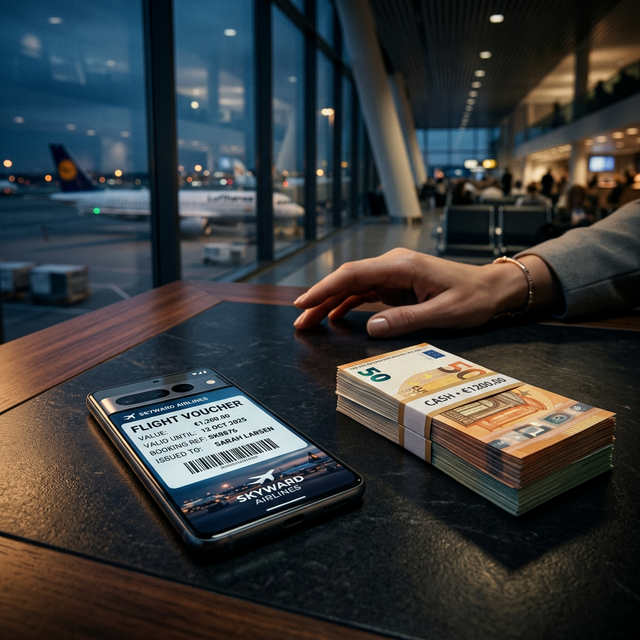
The scene is universally stressful: Your Turkish Airlines flight out of Istanbul (IST) has just been abruptly cancelled, or you've been sitting at the departure gate for five grueling hours watching the estimated departure time slip further into the night. Exhausted, frustrated passengers swarm the customer service desk. Amidst the chaos, a gate agent types furiously on their terminal, prints out a slip of paper, and offers you a choice: accept a travel voucher worth €300 right now, or a deposit of 25,000 Miles&Smiles into your frequent flyer account. It feels like an immediate win, a tangible apology for your ruined day. However, taking that seemingly generous offer is often a critical financial mistake. By accepting a voucher or miles, you may be unknowingly signing away your legal right to a significantly larger, unrestricted cash payout mandate by international aviation law.
1. The Psychology and Strategy of the Gate Offer
To understand why airlines push vouchers so aggressively, you must look at the economics of flight disruptions. When a flight is cancelled due to a technical fault or crew shortage, the airline instantly incurs millions of euros in legal liability under passenger rights frameworks like the European Union's EC 261/2004 or Turkey's equivalent SHY-PASS regulations. For a fully booked widebody jet, the compensation bill alone can easily exceed €180,000.
From a corporate accounting perspective, a cash payout is a total loss. Money physically leaves the airline's bank account. Conversely, issuing a travel voucher or frequent flyer miles costs the airline practically nothing at the moment of issuance. It is merely a liability on a spreadsheet. Airlines rely heavily on "breakage"—the industry term for the high percentage of travel vouchers that are completely forgotten, lost, or expire before the passenger ever manages to use them.
Gate agents are often trained to rapidly deploy these "goodwill" offers to defuse angry crowds and silently clear the airline's legal liability ledger. The agent might casually mention, "I can authorize 20,000 miles to your account right now for the inconvenience," without ever uttering the words "six hundred euros cash."
2. The True Valuation: Miles vs. Statutory Cash
When you are offered "thousands" of miles, it sounds inherently valuable. However, the complex economics of airline loyalty programs paint a different picture, especially regarding Turkish Airlines' Miles&Smiles program.
The Illusion of Miles (e.g., 20,000 Miles)
Real Value: ~€120 to €180. Why is it so low?
- Award seats are subject to intense capacity controls; you rarely find availability during peak holidays.
- Taxes and fuel surcharges are still payable in cash. Booking a "free" flight to New York might still cost €250 in mandatory taxes.
- Miles devalue silently without notice when airlines alter their redemption charts.
The Power of Statutory Cash
Guaranteed Value: Up to €600. The legal reality:
- Real, unrestricted funds wired directly to your bank account via SWIFT.
- Cash never expires and has no blackout dates.
- Can be used to book a flight on a competitor airline, pay your rent, or simply save. It is your money.

3. Understanding The Hidden Restrictions on Vouchers
If you are offered a monetary travel voucher (e.g., a €400 Electronic Miscellaneous Document or EMD) instead of miles, it is crucial to understand the deeply embedded restrictions that diminish its utility compared to raw cash:
- The Clock is Ticking: Almost all Turkish Airlines disruption vouchers carry a strict 12-month expiration date from the date of issue. If you don't travel often, or if your next trip simply doesn't align with Turkish Airlines' routing network, the entire value evaporates at midnight on the 365th day.
- No Name Changes Allowed: Compensation vouchers are bound exclusively to the specific passenger who suffered the delay. You cannot "gift" your €400 voucher to your spouse to help pay for their business trip. Cash, obviously, can be transferred to anyone instantly.
- Fare Exclusions: Airlines frequently encode vouchers so they cannot be applied to deep-discount promotional economy fares, forcing you to purchase a more expensive standard fare class to utilize your "free" money.
- Partial Use Forfeiture: In some historical ticketing systems, using a €400 voucher to purchase a €250 domestic flight resulted in the remaining €150 balance being permanently voided, rather than remaining as a residual credit.
4. The Absolute Law: Written Consent is Mandatory
Both European and Turkish aviation authorities foresaw these exact airline tactics. Because of this, the legislation protecting passengers is unambiguous regarding the method of payment.
Under Article 7, Paragraph 3 of the EU 261/2004 regulation (and mirrored in the Turkish SHY-PASS equivalents), the law dictates:
"The compensation... shall be paid in cash, by electronic bank transfer, bank orders or bank cheques or, with the signed agreement of the passenger, in travel vouchers and/or other services."
This single sentence is your ultimate shield. Turkish Airlines cannot legally force miles or a voucher upon you to settle a compensation claim. They can offer it, but you possess the absolute, unassailable legal right to say "No, I elect to receive the statutory cash amount via bank transfer."
The "Signed Agreement" Trap
Airlines attempt to bypass this law through deceptive paperwork. When they hand you an iPad or a printed receipt to acknowledge receipt of the voucher, heavily scrutinized the fine print. You are looking for phrases like "constitutes full and final settlement of all claims," or "waives future rights under EU261/SHY-PASS." By signing that specific receipt, you are providing the "signed agreement" the law requires, permanently extinguishing your right to a €600 cash claim in exchange for an inferior voucher. Never sign a waiver under pressure at the airport.
5. Do Vouchers Ever Make Sense? (The Rare Exceptions)
As aviation legal experts, we advise declining vouchers in 95% of scenarios. However, there are two distinct, narrow exceptions where accepting a voucher is economically rational:
Exception A: The Premium Multiplier
If you fly Turkish Airlines extensively for business and are absolutely certain you will book a paid ticket within the next three months, and the airline offers a voucher that vastly exceeds your legal cash entitlement. For instance, if your flight delay legally mandates a €250 cash payout, but the gate agent offers a €800 unrestricted flight voucher to ease tensions. If you know you will spend €800 with Turkish Airlines soon anyway, the voucher represents a superior financial return.
Exception B: Extraordinary Circumstances Defeats
If your delay was unequivocally caused by external forces completely outside the airline's control—such as a catastrophic snowstorm closing Istanbul Airport, military airspace closures, or a volcanic eruption—Turkish Airlines is legally absolved from paying any cash compensation. In these "extraordinary circumstances," you have zero legal right to a €600 payout. If, out of goodwill or to quiet a disruptive customer, customer relations later emails you offering 10,000 miles, you should accept them immediately. It is free compensation you had no legal right to secure in the first place.
6. Crucial Distinction: "Right to Care" Does Not Negate "Compensation"
A widespread and damaging misconception leads passengers to believe they must refuse all vouchers at the airport to protect their cash claim. This is false. Passenger rights laws severely bisect immediate assistance and punitive compensation.
| Provision | Examples | Impact on Cash Right |
|---|---|---|
| Article 9: Right to Care | Meal vouchers at the food court, pre-paid hotel room vouchers, taxi vouchers to the hotel. | Accept Freely. Does not affect your right to €600 cash. |
| Article 7: Compensation | Miles&Smiles deposits, future flight discounts, Electronic Miscellaneous Documents (EMDs). | Extreme Caution. Signing for these can void your cash claim. |
If you are stranded overnight in Istanbul, absolutely accept the hotel voucher and the dinner voucher the airline provides. These are your statutory immediate care rights. But politely decline the accompanying "inconvenience voucher" for future flights.
7. Defending Yourself Against the Automatic Miles Deposit
A newer, insidious tactic observed among major carriers involves the unsolicited, automatic deposit of miles into a passenger's frequent flyer account weeks following a severe delay, accompanied by an apologetic email stating, "We have added 15,000 miles to your account as a gesture of goodwill to conclude this matter."
Because you did not "sign" an agreement, the airline cannot legally claim this concludes the matter under European law. However, if you subsequently spend those miles booking a flight, a judge might view your usage as implicit acceptance of the settlement. If you receive an unsolicited miles deposit, the expert protocol is:
- Do not spend, transfer, or interact with the deposited miles.
- Immediately reply to the customer service email thread with a formal rejection: "I acknowledge receipt of the miles deposited on [Date]. However, I do not accept these miles as full and final settlement of my claim, nor have I provided written consent to waive my rights under EU 261/2004 or SHY-PASS. I formally request the removal of these miles from my account and the prompt payment of my statutory cash compensation of €600."
Don't Settle for Miles. Demand Your Cash.
Turkish Airlines relies on passenger fatigue and legal ignorance to offload massive compensation liabilities using nearly worthless digital miles. AirAdvisor's legal team prevents this. We analyze the intricate details of your disruption, reject lowball automated voucher offers, and aggressively pursue the maximum cash payout mandated by law.
Frequently Asked Policy Questions
I foolishly signed a voucher receipt at the stressful airport gate. Is my cash claim permanently dead?
Not necessarily, but your legal battle instantly became significantly harder. Elite aviation attorneys can sometimes invalidate these waivers in civil court by proving "duress" or demonstrating that the airline failed to adequately inform you of your cash rights prior to presenting the voucher (a requirement under Article 14 of EC 261). We handle these complex waiver disputes, so submit your claim for review.
How can I verify if genuine "Extraordinary Circumstances" existed to justify taking the voucher?
You essentially cannot do this alone. Airlines frequently lie, blaming vague "weather" or "ATC strikes" that did not actually affect your specific flight path. Professional claim agencies utilize subscription-based meteorological databases and encrypted air traffic control logs to verify these excuses. Never blindly trust an airline's excuse.
Is there a secondary market? Can I sell my unwanted Turkish Airlines travel voucher online?
No. This is explicitly banned in the Terms & Conditions of nearly all airline compensation instruments. Vouchers are strictly non-transferable and cross-referenced with passenger ID at the time of booking. Selling it on eBay or a forum will result in the airline voiding the voucher without refund, leaving the buyer stranded and you liable for fraud.
Written & Legally Reviewed by Anton Radchenko
Anton is the CEO and Lead Aviation Attorney at AirAdvisor. With over a decade of experience, he has successfully secured compensation for over 250,000 passengers against major airlines globally.